


A few days ago, China Telecom and China Unicom announced that they will open 5G new call ultra-clear video and voice call services in more than 100 major cities. Data show that China has built and opened a total of 1.559 million 5G base stations, and the 5G network has covered all prefecture-level cities and county towns across the country. It is estimated that by 2028, the global lithium-ion battery market for 5G base stations will reach 700 billion yuan. TUES communication base station battery management system (BMS) solution has gone through years of market tests and accurately meets customer needs. TUES energy storage is taking advantage of this strong development trend to take off.
5g emerged with the market demand for high bandwidth, high speed, low latency, and large connection capabilities. The power consumption of 5g base stations is almost 2 to 3 times that of 4g base stations. The excellent characteristics of lithium iron phosphate batteries, which have high energy, long life, low cost, and high safety, meet this demand. They have widely replaced lead-acid batteries as backup power sources for base stations.
BMS is the core equipment to ensure the uninterrupted power supply of base station communication equipment and communication equipment room. A BMS system will transform a group of "dumb" batteries into an intelligent lithium-ion battery pack. Communication base station backup power has many strict requirements on the safety and reliability of BMS. As a BMS expert, TUES Energy Storage ensures the safety and reliability of battery products in an all-round and real-time manner from core chip selection to system level architecture; through multi-branch design, it comprehensively and fully monitors the battery pack voltage, power, temperature, communication and other states to ensure the normal operation of the power system.
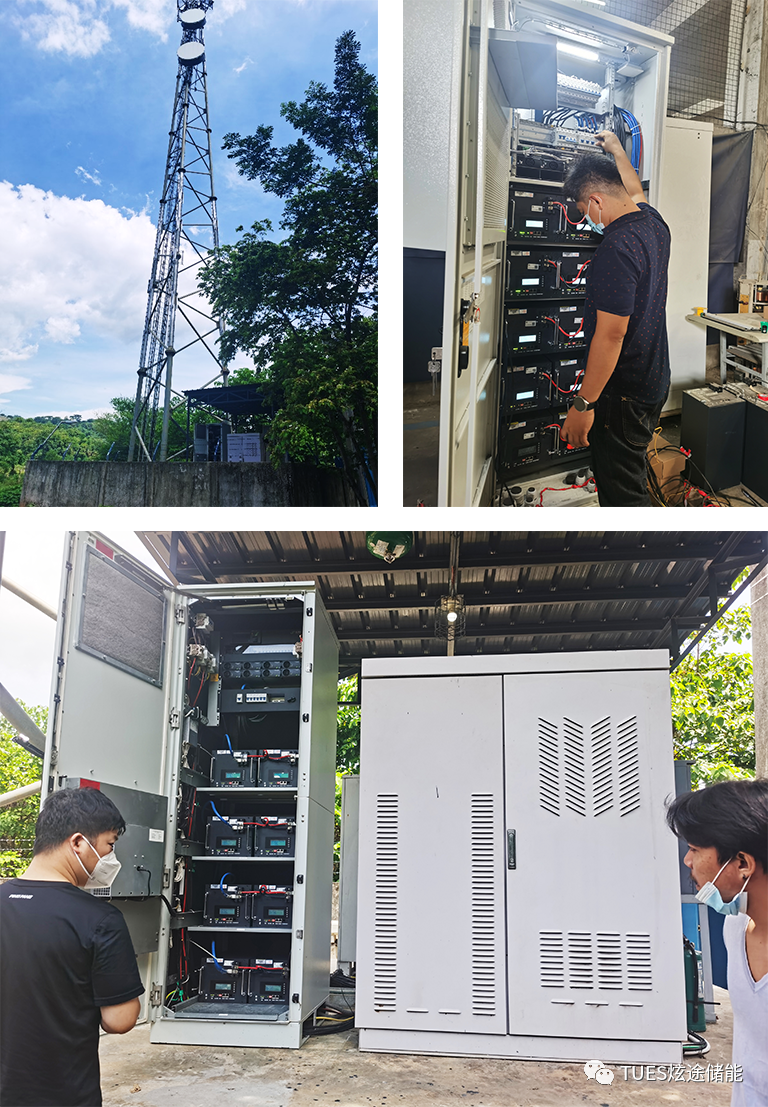
TUES Energy Storage South East Asia Communication Base Station Project
Why choose TUES's communication base station BMS?
smaller temperature rise
Full power operation temperature rise 10~35°C
Rich communication methods
485, CAN, SNMP, TCP/IP, NB-IOT, to meet different needs of customers
Strong parallel capability
Connect 3~100 sets of batteries in parallel according to the needs to meet the capacity expansion requirements of different application scenarios
Stronger adaptability
Parallel connection, pre-charging, heating, current limiting, dry contact, LCD, CAN, etc.
High-precision small current acquisition
The minimum current acquisition range is 0.05A (actual current), which can accurately estimate the SOC of the battery system
 Home
Home Products
 Telephone
 Message